Enable strategic alignment in the organization
Bringing clarity, risk-awareness, and execution into enterprise strategy.
Year
2024
Category
GRC
ROLE
Product Designer
Segment
B2B SaaS
Duration
7 MONTHS
Executive summary
This project delivered a greenfield strategy alignment product that turns strategic logic and risk signals into an explorable decision environment. My responsibility covered the full product design span from discovery and problem framing through UX architecture and high-fidelity design, resulting in implemented product components.
The delivered system supports executive-level decision workflows by making strategic assumptions, tradeoffs, and risk exposure navigable and discussable inside the product. After implementation, the broader initiative was paused due to organizational reprioritization.
01
Challenge
In many mid-sized and enterprise organizations, strategy lives in one of four places:
-PowerPoint decks floating around the organization.
-Strategy playbooks created by advisory firms.
-Scorecards and canvases focused on metrics.
-Personal intuition of senior leaders.
02
The missing element
Strategy management is often treated as a planning or reporting exercise. What is missing is the integration of risk as a first-class strategic input, not as a retrospective audit. Risk managers are brought in late. Executives treat risk as “what not to do”, rather than a source of insight.
03
Design goal
Enable organizational alignment through clear, risk-aware strategy. This was not a presentation tool or a reporting layer. The goal was to design a product that becomes part of how organizations think about strategy, not just how they communicate it. If successful, the product would:
Reduce ambiguity in strategic choices.
Support meaningful executive discussion.
Surface risks early, when they can still influence decisions.
04
The principles we followed
To stay aligned with the business strategy, we defined five guiding principles:
Clarity over completeness – Fewer concepts, explained well
Strategy as a system – Everything is connected
Visible thinking – Strategy should be seen, not buried
Top-down pull – Board usage drives organizational adoption
Fast to change – Designed for iteration, not perfection
01
Challenge
In many mid-sized and enterprise organizations, strategy lives in one of four places:
-PowerPoint decks floating around the organization.
-Strategy playbooks created by advisory firms.
-Scorecards and canvases focused on metrics.
-Personal intuition of senior leaders.
02
The missing element
Strategy management is often treated as a planning or reporting exercise. What is missing is the integration of risk as a first-class strategic input, not as a retrospective audit. Risk managers are brought in late. Executives treat risk as “what not to do”, rather than a source of insight.
03
Design goal
Enable organizational alignment through clear, risk-aware strategy. This was not a presentation tool or a reporting layer. The goal was to design a product that becomes part of how organizations think about strategy, not just how they communicate it. If successful, the product would:
Reduce ambiguity in strategic choices.
Support meaningful executive discussion.
Surface risks early, when they can still influence decisions.
04
The principles I followed
To stay aligned with the business strategy, we defined five guiding principles:
Clarity over completeness – Fewer concepts, explained well
Strategy as a system – Everything is connected
Visible thinking – Strategy should be seen, not buried
Top-down pull – Board usage drives organizational adoption
Fast to change – Designed for iteration, not perfection
Users & Core Tension
Primary users
CEOs and CxOs, Board members, Strategy owners, Risk leaders
The core tension
Executives want fast, confident decisions, while effective strategy demands careful trade-offs and comfort with uncertainty.
Strategy requires:
coherence, trade-offs acknowledgment of uncertainty
Design challenge:
How do we simplify strategic thinking without oversimplifying reality?

Users & Core Tension
Primary users
CEOs and CxOs, Board members, Strategy owners, Risk leaders.
The core tension
Executives want fast, confident decisions, while effective strategy demands careful trade-offs and comfort with uncertainty.
Strategy requires:
Coherence, trade-offs acknowledgment of uncertainty.
Design challenge:
How do we simplify strategic thinking without oversimplifying reality?
Users & Core Tension
Primary users
CEOs and CxOs, Board members, Strategy owners, Risk leaders
The core tension
Executives want fast, confident decisions, while effective strategy demands careful trade-offs and comfort with uncertainty.
Strategy requires:
coherence, trade-offs acknowledgment of uncertainty
Design challenge:
How do we simplify strategic thinking without oversimplifying reality?
Internal Stakeholder Interviews
To ground the product vision in real organizational needs, we conducted multiple internal stakeholder interviews across product, strategy, risk, sales, and leadership functions.
These interviews focused on:
-How strategy is currently created, communicated, and reviewed.
-Where misalignment typically appears.
- How executives evaluate whether a strategy is "working".
-The role of risk, performance, and board oversight in strategic decisions.
A recurring pattern emerged…
Strategy discussions are strong at the top, but clarity degrades rapidly as strategy moves through the organization Teams often execute against interpreted strategy rather than shared strategy Risk is discussed reactively, not structurally, during execution Leadership lacks feedback signals on understanding, buy-in, and feasibility.
These insights validated that the core problem was not tooling efficiency, but organizational sense-making.
Internal Stakeholder Interviews
To ground the product vision in real organizational needs, we conducted multiple internal stakeholder interviews across product, strategy, risk, sales, and leadership functions.
These interviews focused on:
-How strategy is currently created, communicated, and reviewed.
-Where misalignment typically appears.
- How executives evaluate whether a strategy is "working".
-The role of risk, performance, and board oversight in strategic decisions.
A recurring pattern emerged…
Strategy discussions are strong at the top, but clarity degrades rapidly as strategy moves through the organization Teams often execute against interpreted strategy rather than shared strategy Risk is discussed reactively, not structurally, during execution Leadership lacks feedback signals on understanding, buy-in, and feasibility.
These insights validated that the core problem was not tooling efficiency, but organizational sense-making.
Internal Stakeholder Interviews
To ground the product vision in real organizational needs, we conducted multiple internal stakeholder interviews across product, strategy, risk, sales, and leadership functions.
These interviews focused on:
-How strategy is currently created, communicated, and reviewed.
-Where misalignment typically appears.
- How executives evaluate whether a strategy is "working".
-The role of risk, performance, and board oversight in strategic decisions.
A recurring pattern emerged…
Strategy discussions are strong at the top, but clarity degrades rapidly as strategy moves through the organization Teams often execute against interpreted strategy rather than shared strategy Risk is discussed reactively, not structurally, during execution Leadership lacks feedback signals on understanding, buy-in, and feasibility.
These insights validated that the core problem was not tooling efficiency, but organizational sense-making.
Market & Competitive Landscape
In parallel, we analyzed whether this problem was already being solved elsewhere and how the market currently approaches it. We identified three main categories of players attempting to address parts of this problem:
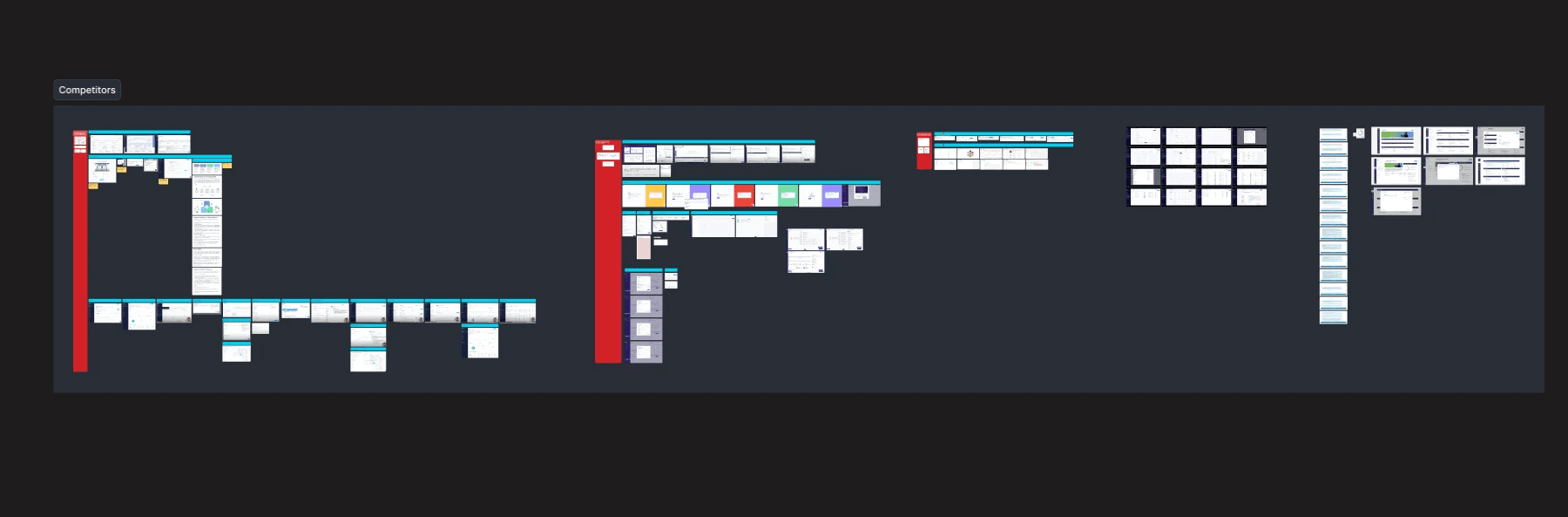
Strategy & Performance Management Tools
OKR platforms and strategic planning softwares. Strong in goal tracking and performance visualization. Typically bottom-up and execution-focused. Strategy often reduced to objectives and metrics Gap: They assume strategy clarity already exists.
01
Presentation & Communication Tools
Slideware and visual collaboration tools. Effective for storytelling in isolated moments. Gap: Strategy becomes static artifacts, not living systems.
02
Risk & Governance Platforms
ERM, GRC, and board management solutions. Strong in oversight, compliance, and risk visibility Natural home for executive-level decision-making Gap: Strategy is often treated as context, not as a managed system.
03
Market & Competitive Landscape
In parallel, we analyzed whether this problem was already being solved elsewhere and how the market currently approaches it. We identified three main categories of players attempting to address parts of this problem:
Strategy & Performance Management Tools
OKR platforms and strategic planning softwares. Strong in goal tracking and performance visualization. Typically bottom-up and execution-focused. Strategy often reduced to objectives and metrics Gap: They assume strategy clarity already exists.
01
Presentation & Communication Tools
Slideware and visual collaboration tools. Effective for storytelling in isolated moments. Gap: Strategy becomes static artifacts, not living systems.
02
Risk & Governance Platforms
ERM, GRC, and board management solutions. Strong in oversight, compliance, and risk visibility Natural home for executive-level decision-making Gap: Strategy is often treated as context, not as a managed system.
03
Market & Competitive Landscape
In parallel, we analyzed whether this problem was already being solved elsewhere and how the market currently approaches it. We identified three main categories of players attempting to address parts of this problem:
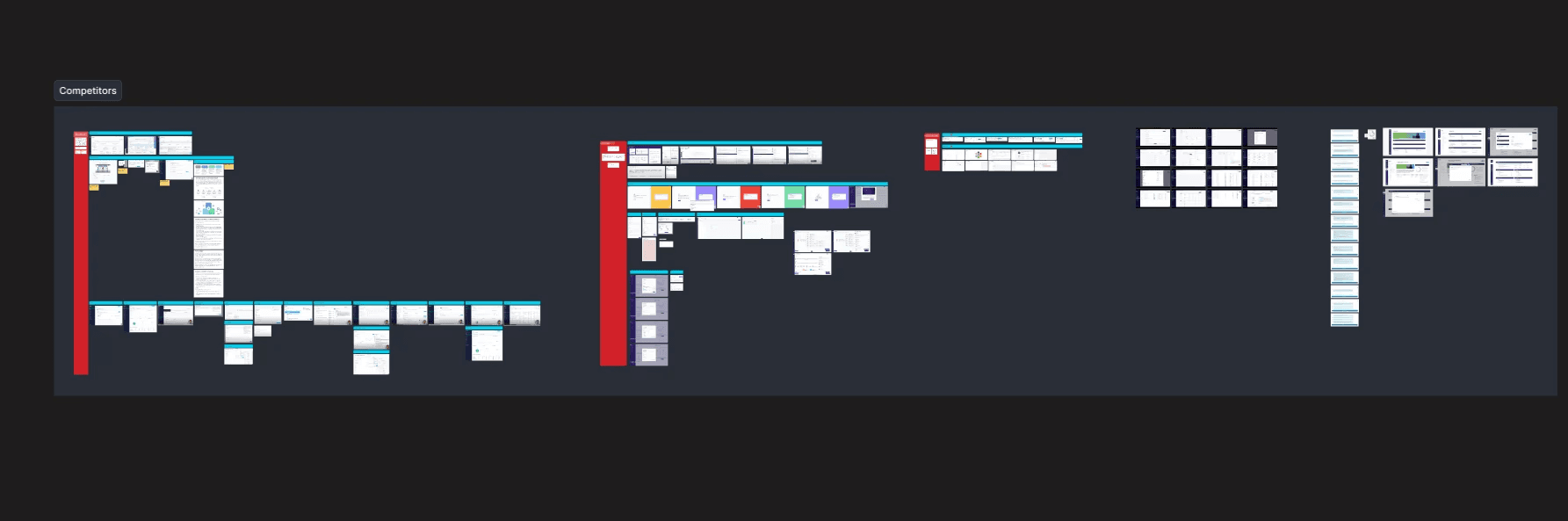
Strategy & Performance Management Tools
OKR platforms and strategic planning softwares. Strong in goal tracking and performance visualization. Typically bottom-up and execution-focused. Strategy often reduced to objectives and metrics Gap: They assume strategy clarity already exists.
01
Presentation & Communication Tools
Slideware and visual collaboration tools. Effective for storytelling in isolated moments. Gap: Strategy becomes static artifacts, not living systems.
02
Risk & Governance Platforms
ERM, GRC, and board management solutions. Strong in oversight, compliance, and risk visibility Natural home for executive-level decision-making Gap: Strategy is often treated as context, not as a managed system.
03
Key insight
No existing category truly owns organizational strategy alignment as a first-class problem.
Most solutions optimize for:
Better tracking
Better reporting
Better presentations
Very few optimize for:
Shared understanding
Strategic coherence
Continuous alignment between intent, risk, and execution
Key insight
No existing category truly owns organizational strategy alignment as a first-class problem.
Most solutions optimize for:
Better tracking
Better reporting
Better presentations
Very few optimize for:
Shared understanding
Strategic coherence
Continuous alignment between intent, risk, and execution
Key insight
No existing category truly owns organizational strategy alignment as a first-class problem.
Most solutions optimize for:
Better tracking
Better reporting
Better presentations
Very few optimize for:
Shared understanding
Strategic coherence
Continuous alignment between intent, risk, and execution
From insight to direction
Based on these insights, we made a conscious decision not to compete within existing categories. Of course, we found points from the analysis that we could leverage, but Instead of building:
A better OKR tool..
A better presentation experience...
Another performance dashboard...
we chose to focus on a problem that was not clearly owned by any existing solution: organizational strategy alignment.
From insight to direction
Based on these insights, we made a conscious decision not to compete within existing categories. Of course, we found points from the analysis that we could leverage, but Instead of building:
A better OKR tool..
A better presentation experience...
Another performance dashboard...
we chose to focus on a problem that was not clearly owned by any existing solution: organizational strategy alignment.
From insight to direction
Based on these insights, we made a conscious decision not to compete within existing categories. Of course, we found points from the analysis that we could leverage, but Instead of building:
A better OKR tool..
A better presentation experience...
Another performance dashboard...
we chose to focus on a problem that was not clearly owned by any existing solution: organizational strategy alignment.
The MVP
Based on the insights and our decision mentioned above, we defined an MVP that covers the essential problems while keeping the scope manageable.
While many features could have been included, we intentionally kept the MVP problem focused designed to directly address the key pain points rather than deliver a broad set of functionalities.
01
Predefined Strategy Elements
To ensure consistency and guide users, predefined elements were included so that strategies could be built in a structured and aligned way.
02
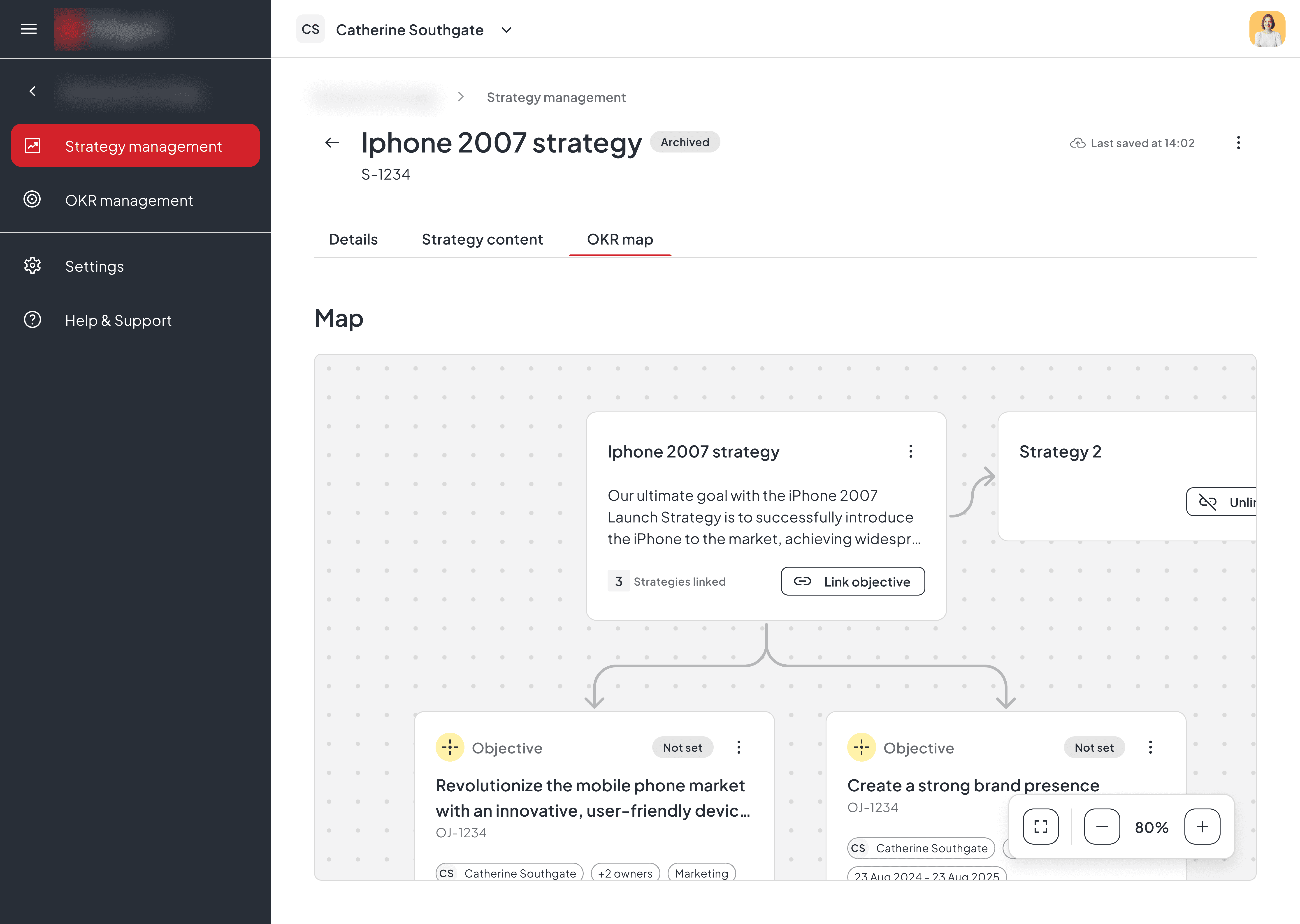
OKR Map
A central tool for building and visualizing Objectives and Key Results, enabling Strategy Owners to create a coherent strategy and track progress.
03
Strategic Dashboard
Provides leadership with a high-level view of how strategies are evolving, highlighting critical changes, whether in Objectives, Key Results, KPIs, or Risks..so users can make informed, timely decisions.
04
Presentation Mode
Enables Strategy Owners to communicate their strategy clearly to stakeholders, framing the OKR Map as a strategic narrative rather than just a list of metrics. This supports alignment discussions and decision-making at a business level.
05
Collaborative Alignment
Contributors can engage with the strategy through commenting and feedback, supporting alignment across teams without creating conflicts. Collaboration is built in as a mechanism for strategic coherence, not just a nice-to-have feature.
After defining the MVP and gathering the relevant information, I began designing the user flows and journeys, which we then reviewed and discussed with the team…
Following several pages of sketches to explore ideas and refine concepts, I started diving into high-fidelity design, translating the early concepts into detailed, interactive layouts.
The MVP
Based on the insights and our decision mentioned above, we defined an MVP that covers the essential problems while keeping the scope manageable.
While many features could have been included, we intentionally kept the MVP problem focused designed to directly address the key pain points rather than deliver a broad set of functionalities.
01
Predefined Strategy Elements
To ensure consistency and guide users, predefined elements were included so that strategies could be built in a structured and aligned way.
02
OKR Map
A central tool for building and visualizing Objectives and Key Results, enabling Strategy Owners to create a coherent strategy and track progress.
03
Strategic Dashboard
Provides leadership with a high-level view of how strategies are evolving, highlighting critical changes, whether in Objectives, Key Results, KPIs, or Risks..so users can make informed, timely decisions.
04
Presentation Mode
Enables Strategy Owners to communicate their strategy clearly to stakeholders, framing the OKR Map as a strategic narrative rather than just a list of metrics. This supports alignment discussions and decision-making at a business level.
05
Collaborative Alignment
Contributors can engage with the strategy through commenting and feedback, supporting alignment across teams without creating conflicts. Collaboration is built in as a mechanism for strategic coherence, not just a nice-to-have feature.
After defining the MVP and gathering the relevant information, I began designing the user flows and journeys, which we then reviewed and discussed with the team…
Following several pages of sketches to explore ideas and refine concepts, I started diving into high-fidelity design, translating the early concepts into detailed, interactive layouts.
The MVP
Based on the insights and our decision mentioned above, we defined an MVP that covers the essential problems while keeping the scope manageable.
While many features could have been included, we intentionally kept the MVP problem focused designed to directly address the key pain points rather than deliver a broad set of functionalities.
01
Predefined Strategy Elements
To ensure consistency and guide users, predefined elements were included so that strategies could be built in a structured and aligned way.
02
OKR Map
A central tool for building and visualizing Objectives and Key Results, enabling Strategy Owners to create a coherent strategy and track progress.
03
Strategic Dashboard
Provides leadership with a high-level view of how strategies are evolving, highlighting critical changes, whether in Objectives, Key Results, KPIs, or Risks..so users can make informed, timely decisions.
04
Presentation Mode
Enables Strategy Owners to communicate their strategy clearly to stakeholders, framing the OKR Map as a strategic narrative rather than just a list of metrics. This supports alignment discussions and decision-making at a business level.
05
Collaborative Alignment
Contributors can engage with the strategy through commenting and feedback, supporting alignment across teams without creating conflicts. Collaboration is built in as a mechanism for strategic coherence, not just a nice-to-have feature.
After defining the MVP and gathering the relevant information, I began designing the user flows and journeys, which we then reviewed and discussed with the team…
Following several pages of sketches to explore ideas and refine concepts, I started diving into high-fidelity design, translating the early concepts into detailed, interactive layouts.
01
Creating a shared language for strategy
Standardised building blocks for clear, aligned strategy.
The problem it addresses
In large organisations, strategy discussions often break down due to inconsistent structure and language. Teams describe similar concepts in different ways, strategies become overly verbose or fragmented, and critical context gets lost when strategies are shared, presented, or revisited over time. Without a common structure, strategy becomes difficult to compare, evolve, or connect, especially across organisational units and leadership levels.
The design intent
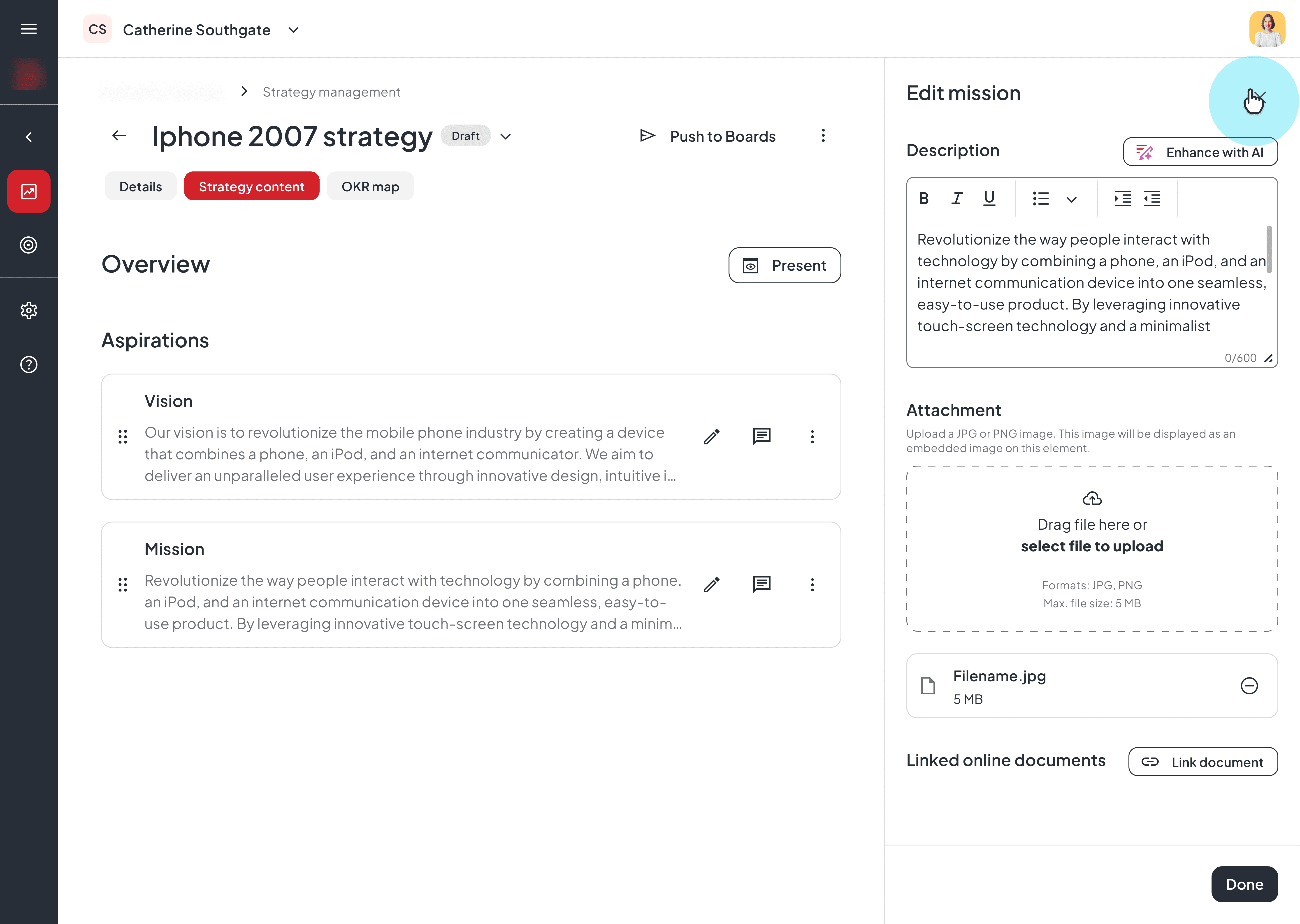
The Strategy Elements were designed as standardised building blocks of strategy. Rather than over-innovating on individual elements, we intentionally focused on simplicity, clarity, and consistency.
Each element follows the same highlevel structure: a clear name, concise descriptions, and optional depth, allowing users to focus on what they are saying, not how to structure it. By providing predefined elements (such as Vision, Sales Tactics, Competition, Investment Needs, or Financial Projections), the system helps teams speak the same strategic language across the organisation.
The outcome
The result is a strategy that is easier to build, easier to understand, and easier to communicate. Strategy Elements create a shared foundation that supports alignment, comparison, and reuse, while remaining flexible enough to accommodate different strategic contexts and levels of detail. They also serve as the conceptual backbone for higher-level features, such as the OKR Map, ensuring that execution is always grounded in clearly articulated strategic intent.
01
Creating a shared language for strategy
Standardised building blocks for clear, aligned strategy.
The problem it addresses
In large organisations, strategy discussions often break down due to inconsistent structure and language. Teams describe similar concepts in different ways, strategies become overly verbose or fragmented, and critical context gets lost when strategies are shared, presented, or revisited over time. Without a common structure, strategy becomes difficult to compare, evolve, or connect, especially across organisational units and leadership levels.
The design intent
The Strategy Elements were designed as standardised building blocks of strategy. Rather than over-innovating on individual elements, we intentionally focused on simplicity, clarity, and consistency.
Each element follows the same highlevel structure: a clear name, concise descriptions, and optional depth, allowing users to focus on what they are saying, not how to structure it. By providing predefined elements (such as Vision, Sales Tactics, Competition, Investment Needs, or Financial Projections), the system helps teams speak the same strategic language across the organisation.
The outcome
The result is a strategy that is easier to build, easier to understand, and easier to communicate. Strategy Elements create a shared foundation that supports alignment, comparison, and reuse, while remaining flexible enough to accommodate different strategic contexts and levels of detail. They also serve as the conceptual backbone for higher-level features, such as the OKR Map, ensuring that execution is always grounded in clearly articulated strategic intent.
01
Creating a shared language for strategy
Standardised building blocks for clear, aligned strategy.
The problem it addresses
In large organisations, strategy discussions often break down due to inconsistent structure and language. Teams describe similar concepts in different ways, strategies become overly verbose or fragmented, and critical context gets lost when strategies are shared, presented, or revisited over time. Without a common structure, strategy becomes difficult to compare, evolve, or connect, especially across organisational units and leadership levels.
The design intent
The Strategy Elements were designed as standardised building blocks of strategy. Rather than over-innovating on individual elements, we intentionally focused on simplicity, clarity, and consistency.
Each element follows the same highlevel structure: a clear name, concise descriptions, and optional depth, allowing users to focus on what they are saying, not how to structure it. By providing predefined elements (such as Vision, Sales Tactics, Competition, Investment Needs, or Financial Projections), the system helps teams speak the same strategic language across the organisation.
The outcome
The result is a strategy that is easier to build, easier to understand, and easier to communicate. Strategy Elements create a shared foundation that supports alignment, comparison, and reuse, while remaining flexible enough to accommodate different strategic contexts and levels of detail. They also serve as the conceptual backbone for higher-level features, such as the OKR Map, ensuring that execution is always grounded in clearly articulated strategic intent.
Strategy Elements – Breakdown
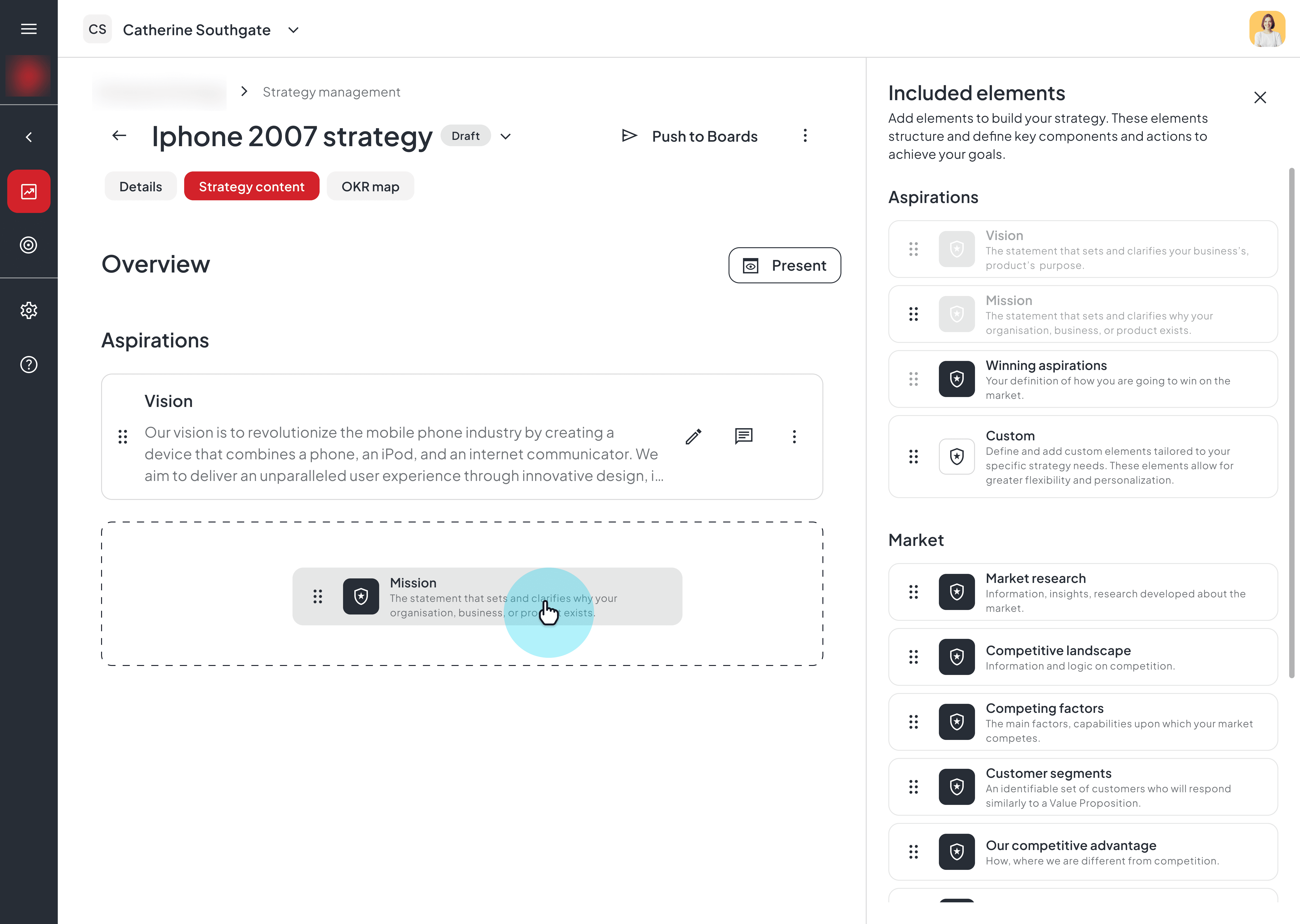
Standardised structure, flexible content
Each Strategy Element follows the same consistent structure: a clear name, a short summary, optional longer descriptions, and supporting materials such as images. This allows users to quickly scan, understand, and present strategy, while still enabling deeper context when needed. By standardising the format rather than the content, the system supports both clarity and nuance, without overwhelming users with unnecessary complexity.
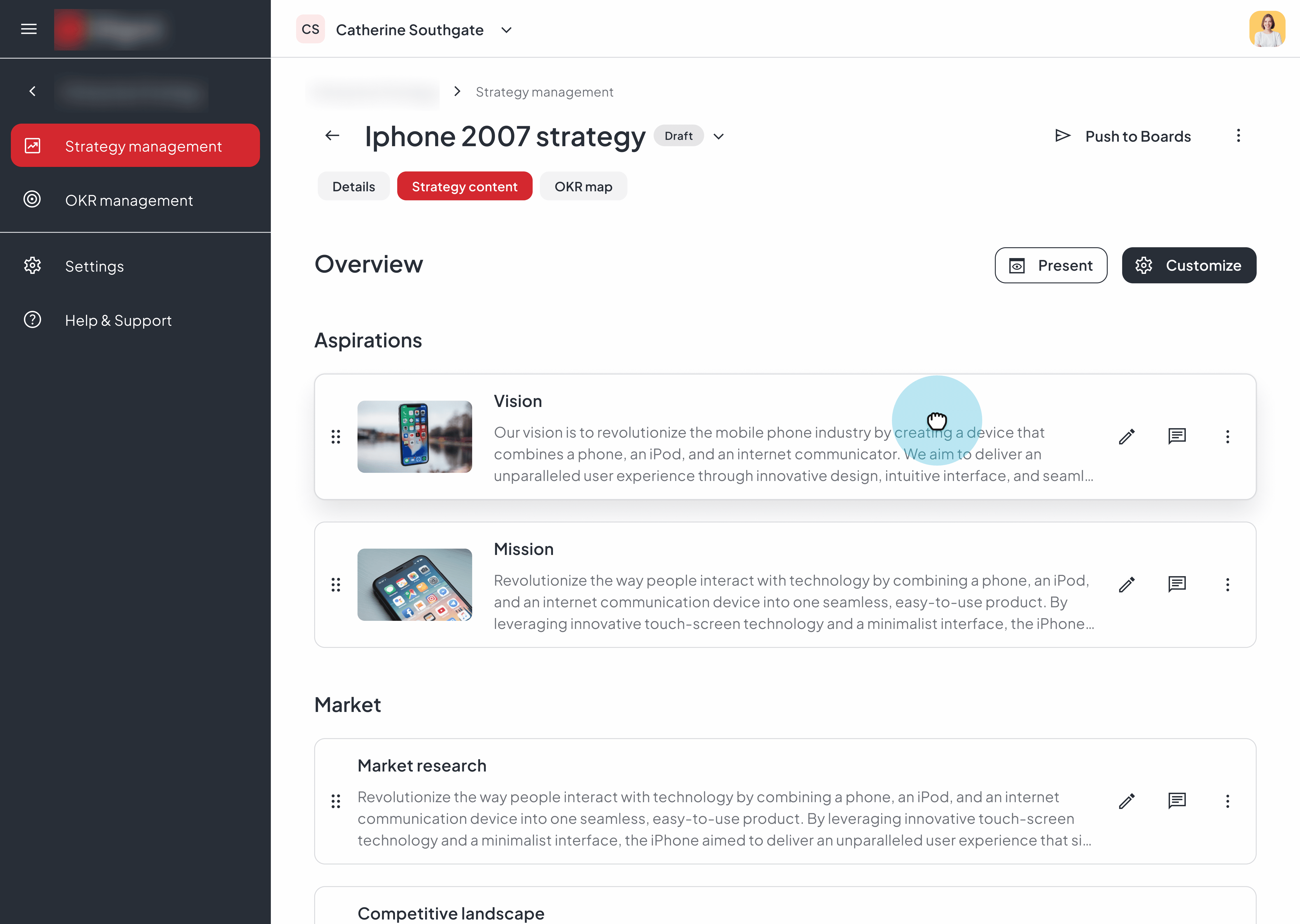
Enabling structured collaboration around strategic intent
Strategy Elements are not treated as static documentation, but as shared discussion spaces. Users can leave comments directly on individual elements, allowing teams to ask questions, challenge assumptions, and provide feedback in the exact context where strategic decisions are defined.
Why these elements matters
Strategy Elements create a shared, standardized language for strategy work, turning inherently abstract concepts—like positioning, competition, or investment needs—into clear, comparable, and reusable building blocks across the organization. By simplifying how strategy is defined, communicated, and evaluated, they reduce ambiguity, accelerate alignment, and enable teams to make more consistent, data‑informed decisions at scale.
Strategy Elements – Breakdown
Standardised structure, flexible content
Each Strategy Element follows the same consistent structure: a clear name, a short summary, optional longer descriptions, and supporting materials such as images. This allows users to quickly scan, understand, and present strategy, while still enabling deeper context when needed. By standardising the format rather than the content, the system supports both clarity and nuance, without overwhelming users with unnecessary complexity.
Enabling structured collaboration around strategic intent
Strategy Elements are not treated as static documentation, but as shared discussion spaces. Users can leave comments directly on individual elements, allowing teams to ask questions, challenge assumptions, and provide feedback in the exact context where strategic decisions are defined.
Why these elements matters
Strategy Elements create a shared, standardized language for strategy work, turning inherently abstract concepts..like positioning, competition, or investment needs,into clear, comparable, and reusable building blocks across the organization. By simplifying how strategy is defined, communicated, and evaluated, they reduce ambiguity, accelerate alignment, and enable teams to make more consistent, data‑informed decisions at scale.
Strategy Elements – Breakdown
Standardised structure, flexible content
Each Strategy Element follows the same consistent structure: a clear name, a short summary, optional longer descriptions, and supporting materials such as images. This allows users to quickly scan, understand, and present strategy, while still enabling deeper context when needed. By standardising the format rather than the content, the system supports both clarity and nuance, without overwhelming users with unnecessary complexity.
Enabling structured collaboration around strategic intent
Strategy Elements are not treated as static documentation, but as shared discussion spaces. Users can leave comments directly on individual elements, allowing teams to ask questions, challenge assumptions, and provide feedback in the exact context where strategic decisions are defined.
Why these elements matters
Strategy Elements create a shared, standardized language for strategy work, turning inherently abstract concepts—like positioning, competition, or investment needs—into clear, comparable, and reusable building blocks across the organization. By simplifying how strategy is defined, communicated, and evaluated, they reduce ambiguity, accelerate alignment, and enable teams to make more consistent, data‑informed decisions at scale.
02
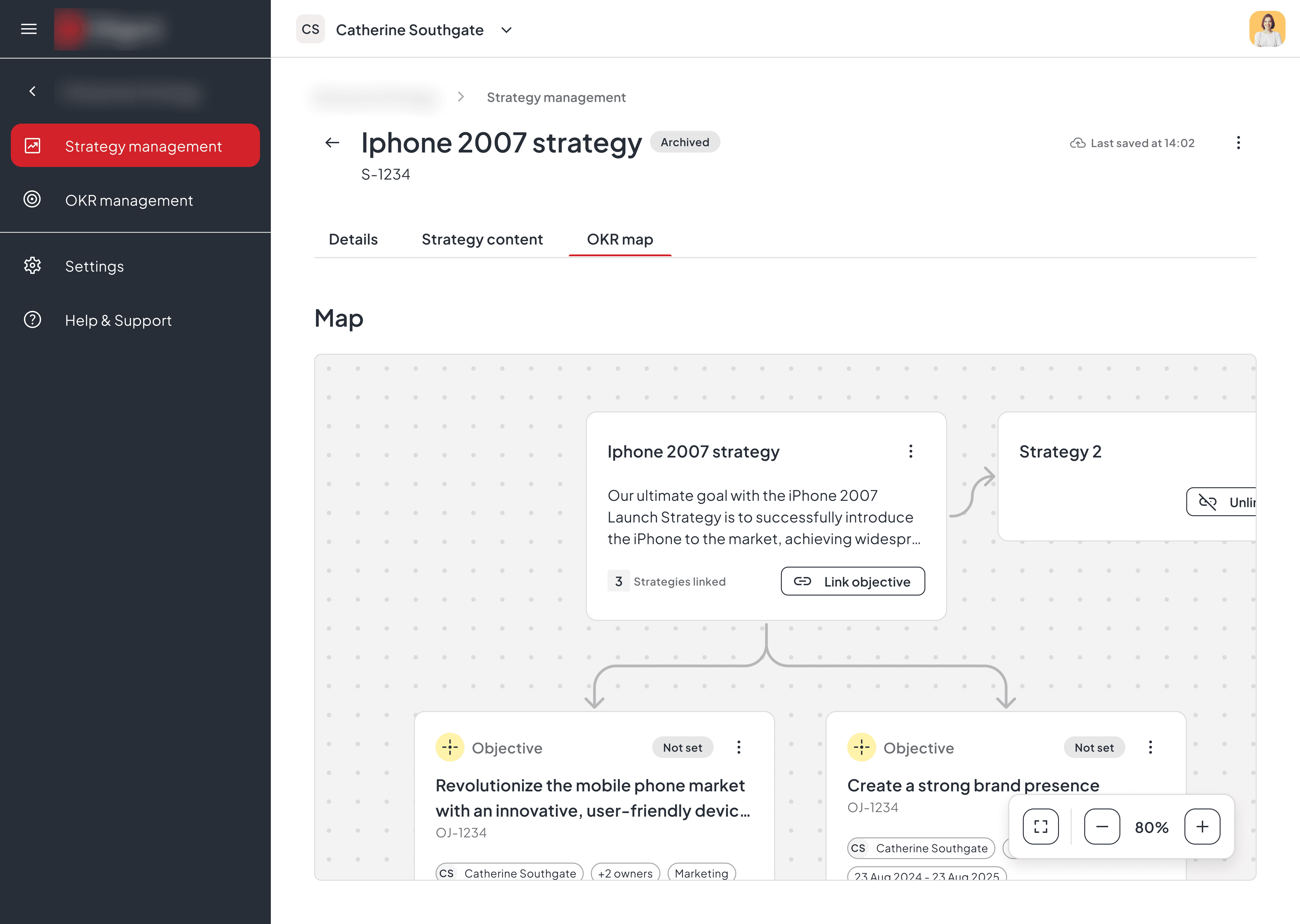
From Static Strategy to Living OKRs
A shared, visual OKR Map that helps leaders and teams align, discuss, and continuously mature strategy across the organisation.
The problem it addresses
In large organisations, strategies often fail not because they are poorly defined, but because they are hard to operationalise. Objectives live in decks, key results in spreadsheets, and progress updates in siloed tools. This fragmentation makes it difficult for leaders to understand how strategic intent translates into real outcomes and for teams to see how their work connects back to strategy.
The design intent
The OKR Map was designed as a central orchestration layer between strategy definition and execution. Instead of enforcing rigid hierarchies, we intentionally modelled OKRs as a network, allowing objectives, key results, and risks to connect across strategies, organisational units, and ownership boundaries. This reflects how strategy actually evolves in complex enterprises.
The outcome
The result is a shared mental model for strategy: one that supports building, presenting, discussing, and continuously refining OKRs over time. Strategy Owners can clearly articulate intent, Contributors can meaningfully engage and iterate, and leadership gains visibility into alignment and progress, all in one place.
02
From Static Strategy to Living OKRs
A shared, visual OKR Map that helps leaders and teams align, discuss, and continuously mature strategy across the organisation.
The problem it addresses
In large organisations, strategies often fail not because they are poorly defined, but because they are hard to operationalise. Objectives live in decks, key results in spreadsheets, and progress updates in siloed tools. This fragmentation makes it difficult for leaders to understand how strategic intent translates into real outcomes and for teams to see how their work connects back to strategy.
The design intent
The OKR Map was designed as a central orchestration layer between strategy definition and execution. Instead of enforcing rigid hierarchies, we intentionally modelled OKRs as a network, allowing objectives, key results, and risks to connect across strategies, organisational units, and ownership boundaries. This reflects how strategy actually evolves in complex enterprises.
The outcome
The result is a shared mental model for strategy: one that supports building, presenting, discussing, and continuously refining OKRs over time. Strategy Owners can clearly articulate intent, Contributors can meaningfully engage and iterate, and leadership gains visibility into alignment and progress, all in one place.
02
From Static Strategy to Living OKRs
A shared, visual OKR Map that helps leaders and teams align, discuss, and continuously mature strategy across the organisation.
The problem it addresses
In large organisations, strategies often fail not because they are poorly defined, but because they are hard to operationalise. Objectives live in decks, key results in spreadsheets, and progress updates in siloed tools. This fragmentation makes it difficult for leaders to understand how strategic intent translates into real outcomes and for teams to see how their work connects back to strategy.
The design intent
The OKR Map was designed as a central orchestration layer between strategy definition and execution. Instead of enforcing rigid hierarchies, we intentionally modelled OKRs as a network, allowing objectives, key results, and risks to connect across strategies, organisational units, and ownership boundaries. This reflects how strategy actually evolves in complex enterprises.
The outcome
The result is a shared mental model for strategy: one that supports building, presenting, discussing, and continuously refining OKRs over time. Strategy Owners can clearly articulate intent, Contributors can meaningfully engage and iterate, and leadership gains visibility into alignment and progress, all in one place.
OKR Map breakdown
Creating OKRs in context, not in isolation
Strategy Owners start from an already defined strategic foundation: vision, goals, and more strategic elements. They can build OKRs directly on top of it. Objectives and Key Results, Risks are added incrementally, renamed, refined, or removed as understanding deepens. This supports a learning-driven strategy process, where clarity emerges through iteration rather than upfront perfection.
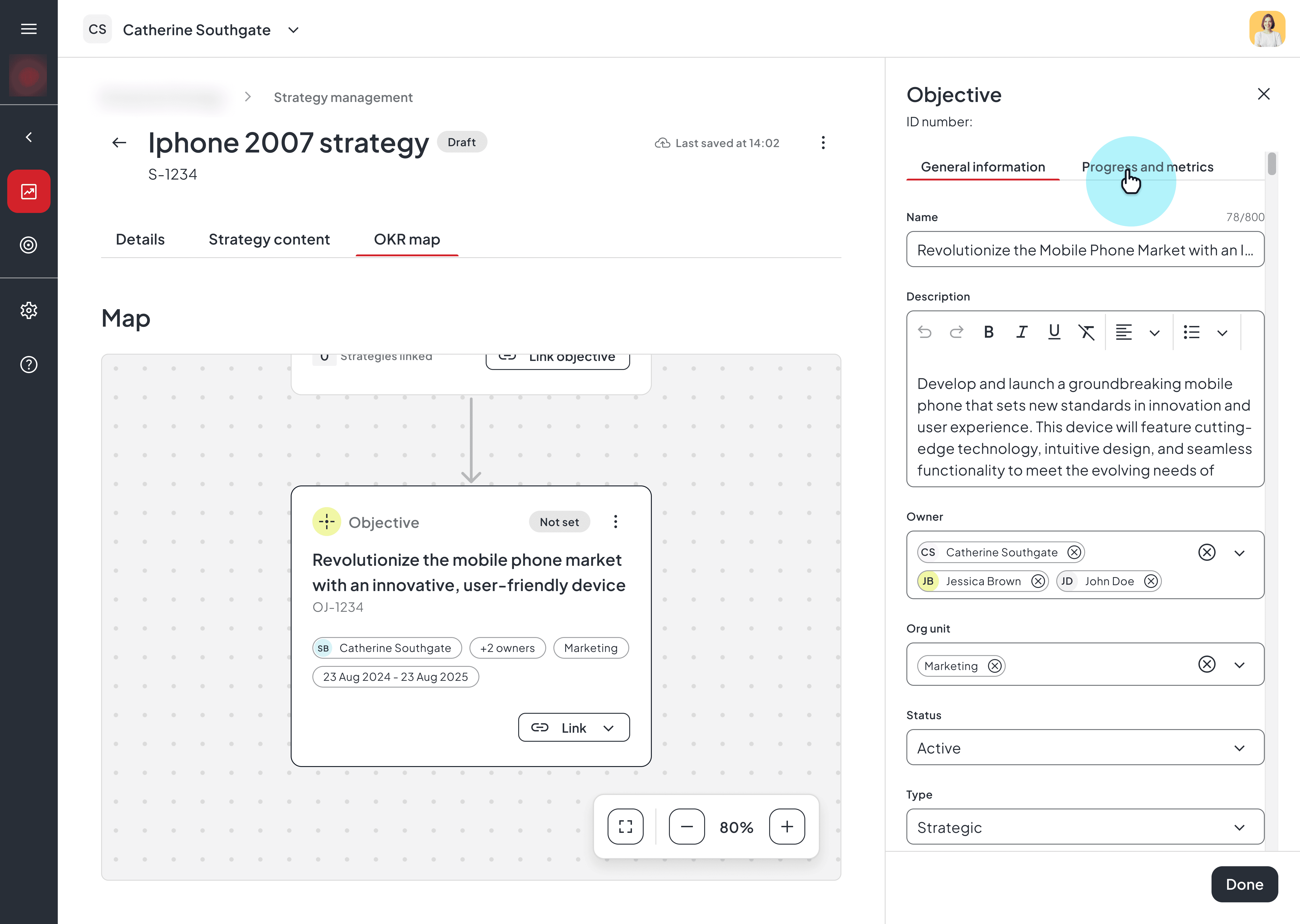
Operationalising OKRs through ownership, structure, and measurable outcomes
Objectives and Key Results, Risks are not just defined ..they are owned, structured, and actively managed. Within the OKR Map, owners can assign responsibility, link these objects to organisational units, and explicitly set status, progress, and success metrics.
Why the OKR Map matters
The OKR Map enables users to align objectives, measure progress, and manage risks in one connected model. By making ownership, progress, and risk explicit, it helps organisations execute strategy with clarity, accountability, and awareness.
OKR Map breakdown
Creating OKRs in context, not in isolation
Strategy Owners start from an already defined strategic foundation: vision, goals, and more strategic elements. They can build OKRs directly on top of it. Objectives and Key Results, Risks are added incrementally, renamed, refined, or removed as understanding deepens. This supports a learning-driven strategy process, where clarity emerges through iteration rather than upfront perfection.
Operationalising OKRs through ownership, structure, and measurable outcomes
Objectives and Key Results, Risks are not just defined ..they are owned, structured, and actively managed. Within the OKR Map, owners can assign responsibility, link these objects to organisational units, and explicitly set status, progress, and success metrics.
Why the OKR Map matters
The OKR Map enables users to align objectives, measure progress, and manage risks in one connected model. By making ownership, progress, and risk explicit, it helps organisations execute strategy with clarity, accountability, and awareness.
OKR Map breakdown
Creating OKRs in context, not in isolation
Strategy Owners start from an already defined strategic foundation: vision, goals, and more strategic elements. They can build OKRs directly on top of it. Objectives and Key Results, Risks are added incrementally, renamed, refined, or removed as understanding deepens. This supports a learning-driven strategy process, where clarity emerges through iteration rather than upfront perfection.
Operationalising OKRs through ownership, structure, and measurable outcomes
Objectives and Key Results, Risks are not just defined ..they are owned, structured, and actively managed. Within the OKR Map, owners can assign responsibility, link these objects to organisational units, and explicitly set status, progress, and success metrics.
Why the OKR Map matters
The OKR Map enables users to align objectives, measure progress, and manage risks in one connected model. By making ownership, progress, and risk explicit, it helps organisations execute strategy with clarity, accountability, and awareness.
03
High‑Level Strategy Dashboard
A single, real‑time view that brings strategic clarity to the entire organization.
The problem it addresses
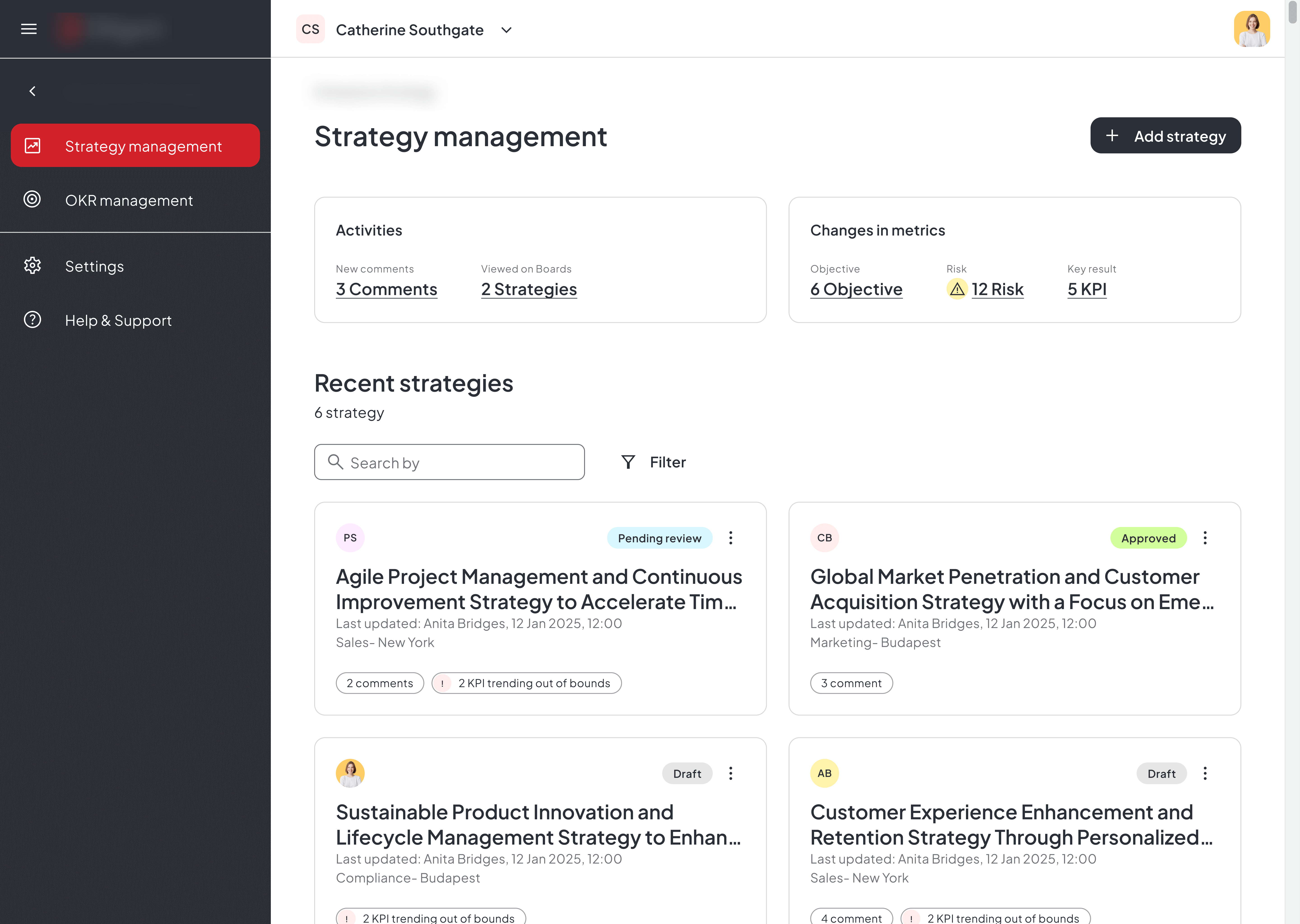
As organizations mature, the volume, velocity, and complexity of their strategic initiatives grow. While OKR Maps reveal alignment and Strategy Elements standardize language, leaders still lack a centralized place to monitor how strategies evolve, where issues emerge, and what decisions require their attention. The High‑Level Dashboard addresses this gap by giving executives and teams a unified, always‑up‑to‑date picture of the health, progress, and risks of their strategy landscape.
The design intent
The goal was to design a high-level cockpit that surfaces only what matters: the momentum of strategic initiatives, their interdependencies, key risks, and upcoming decision points. The dashboard had to be visually lightweight, cognitively low‑load, and prioritization‑friendly—enabling leaders to instantly understand the state of their organization without diving into multiple screens.
The outcome
With the High‑Level Dashboard in place, leadership gets real‑time indicators of progress, bottlenecks, ownership, and risk exposure. Instead of weekly meetings to “sync the strategy,” teams can focus their conversations on solutions and actions.
03
High‑Level Strategy Dashboard
A single, real‑time view that brings strategic clarity to the entire organization.
The problem it addresses
As organizations mature, the volume, velocity, and complexity of their strategic initiatives grow. While OKR Maps reveal alignment and Strategy Elements standardize language, leaders still lack a centralized place to monitor how strategies evolve, where issues emerge, and what decisions require their attention. The High‑Level Dashboard addresses this gap by giving executives and teams a unified, always‑up‑to‑date picture of the health, progress, and risks of their strategy landscape.
The design intent
The goal was to design a high-level cockpit that surfaces only what matters: the momentum of strategic initiatives, their interdependencies, key risks, and upcoming decision points. The dashboard had to be visually lightweight, cognitively low‑load, and prioritization‑friendly—enabling leaders to instantly understand the state of their organization without diving into multiple screens.
The outcome
With the High‑Level Dashboard in place, leadership gets real‑time indicators of progress, bottlenecks, ownership, and risk exposure. Instead of weekly meetings to “sync the strategy,” teams can focus their conversations on solutions and actions.
03
High‑Level Strategy Dashboard
A single, real‑time view that brings strategic clarity to the entire organization.
The problem it addresses
As organizations mature, the volume, velocity, and complexity of their strategic initiatives grow. While OKR Maps reveal alignment and Strategy Elements standardize language, leaders still lack a centralized place to monitor how strategies evolve, where issues emerge, and what decisions require their attention. The High‑Level Dashboard addresses this gap by giving executives and teams a unified, always‑up‑to‑date picture of the health, progress, and risks of their strategy landscape.
The design intent
The goal was to design a high-level cockpit that surfaces only what matters: the momentum of strategic initiatives, their interdependencies, key risks, and upcoming decision points. The dashboard had to be visually lightweight, cognitively low‑load, and prioritization‑friendly—enabling leaders to instantly understand the state of their organization without diving into multiple screens.
The outcome
With the High‑Level Dashboard in place, leadership gets real‑time indicators of progress, bottlenecks, ownership, and risk exposure. Instead of weekly meetings to “sync the strategy,” teams can focus their conversations on solutions and actions.
Dashboard breakdown
The heartbeat of strategic progress.
This view aggregates all active strategies into a single overview panel, displaying their status, trajectory, confidence levels, and risk indicators. It allows leaders to understand at a glance which initiatives are on track, which require intervention, and where emerging patterns may signal misalignment or opportunity. The design intentionally reduces noise and builds trust through clarity and consistency.
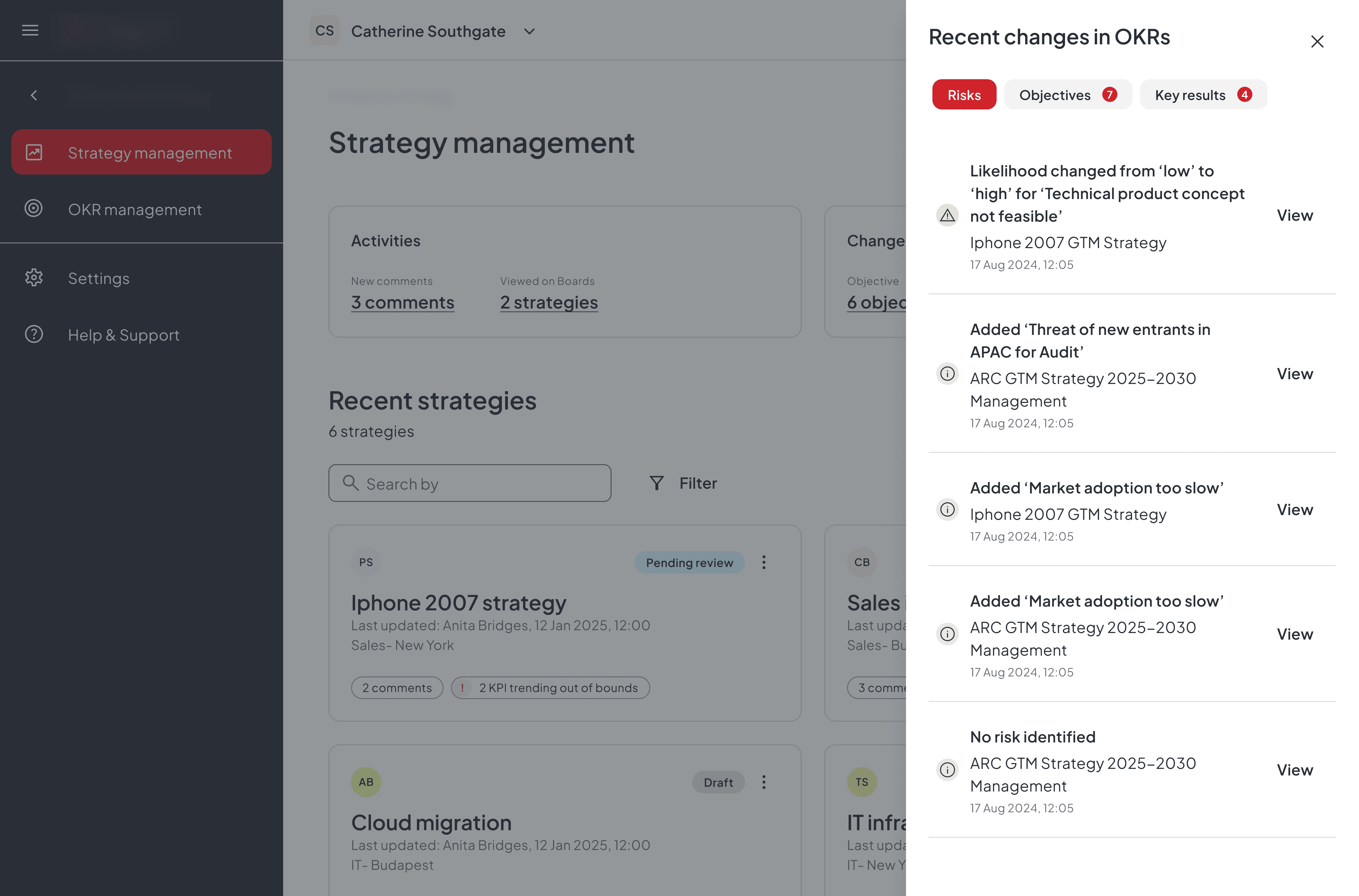
A dynamic feed of changes that shape your strategy.
This view surfaces all meaningful events that could influence a given strategy: from OKR updates and shifting priorities to risk signals, ownership changes, or new dependencies. Instead of hunting for updates across teams and tools, leaders see a curated, contextualized stream of what has changed, why it matters, and which strategies may be affected. It turns scattered updates into actionable intelligence, allowing teams to respond faster and adjust their strategic path with confidence.
Why the dashboard matters
The High‑Level Strategy Dashboard matters because it gives leaders a continuously updated, unified understanding of how their strategies evolve.. not just in terms of progress, but in response to real organizational change. By combining real‑time strategic metrics with a curated stream of meaningful events and notifications, it becomes possible to spot emerging risks, understand the impact of OKR changes, and react before misalignment spreads. This transforms strategy from a static plan into a living system: one that surfaces what’s changing, why it matters, and where actions are needed
While several further concepts were in progress (including Presentation Mode and AI flows), the project concluded at this point, so this case study focuses on the completed core foundations.
Dashboard breakdown
The heartbeat of strategic progress.
This view aggregates all active strategies into a single overview panel, displaying their status, trajectory, confidence levels, and risk indicators. It allows leaders to understand at a glance which initiatives are on track, which require intervention, and where emerging patterns may signal misalignment or opportunity. The design intentionally reduces noise and builds trust through clarity and consistency.
A dynamic feed of changes that shape your strategy.
This view surfaces all meaningful events that could influence a given strategy: from OKR updates and shifting priorities to risk signals, ownership changes, or new dependencies. Instead of hunting for updates across teams and tools, leaders see a curated, contextualized stream of what has changed, why it matters, and which strategies may be affected. It turns scattered updates into actionable intelligence, allowing teams to respond faster and adjust their strategic path with confidence.
Why the dashboard matters
The High‑Level Strategy Dashboard matters because it gives leaders a continuously updated, unified understanding of how their strategies evolve.. not just in terms of progress, but in response to real organizational change. By combining real‑time strategic metrics with a curated stream of meaningful events and notifications, it becomes possible to spot emerging risks, understand the impact of OKR changes, and react before misalignment spreads. This transforms strategy from a static plan into a living system: one that surfaces what’s changing, why it matters, and where actions are needed
While several further concepts were in progress (including Presentation Mode and AI flows), the project concluded at this point, so this case study focuses on the completed core foundations.
Dashboard breakdown
The heartbeat of strategic progress.
This view aggregates all active strategies into a single overview panel, displaying their status, trajectory, confidence levels, and risk indicators. It allows leaders to understand at a glance which initiatives are on track, which require intervention, and where emerging patterns may signal misalignment or opportunity. The design intentionally reduces noise and builds trust through clarity and consistency.
A dynamic feed of changes that shape your strategy.
This view surfaces all meaningful events that could influence a given strategy: from OKR updates and shifting priorities to risk signals, ownership changes, or new dependencies. Instead of hunting for updates across teams and tools, leaders see a curated, contextualized stream of what has changed, why it matters, and which strategies may be affected. It turns scattered updates into actionable intelligence, allowing teams to respond faster and adjust their strategic path with confidence.
Why the dashboard matters
The High‑Level Strategy Dashboard matters because it gives leaders a continuously updated, unified understanding of how their strategies evolve.. not just in terms of progress, but in response to real organizational change. By combining real‑time strategic metrics with a curated stream of meaningful events and notifications, it becomes possible to spot emerging risks, understand the impact of OKR changes, and react before misalignment spreads. This transforms strategy from a static plan into a living system: one that surfaces what’s changing, why it matters, and where actions are needed
While several further concepts were in progress (including Presentation Mode and AI flows), the project concluded at this point, so this case study focuses on the completed core foundations.
Outcome
The designed framework and interaction model were implemented and integrated into the product environment. The solution established a clearer strategic decision structure and shared language between strategy and risk stakeholders. Following implementation, the broader product initiative was later paused due to organizational reprioritization — not due to product or usability issues. The delivered system transformed static strategy artifacts into an explorable decision model, supporting structured executive decision-making under uncertainty.
01
Designing for leaders means DESIGNING FOR DECISION-MAKING.
By stepping into the shoes of CISOs and executive stakeholders, I learned how different their needs are from day-to-day users. The focus wasn’t on more features or data, but on clarity, prioritization, and confidence. This insight shaped how I reduced cognitive load and surfaced only the signals that truly supported strategic decisions.
02
DESIGN IMPACT GOES BEYOND SHIPPED FEATURES.
Design impact extends beyond feature delivery. The core concepts and interaction patterns were implemented and validated in practice. Even though the broader initiative was later paused, the shipped components established a working strategic decision framework and stakeholder alignment model.
03
MISALIGNMENT HAS REAL COSTS.
As the project evolved, it became clear how easily misalignment can slow teams down, create confusion, and weaken strategic execution. Designing in this environment strengthened my ability to navigate ambiguity, ask the right questions, and help teams regain focus around a shared understanding of priorities.
Outcome
The designed framework and interaction model were implemented and integrated into the product environment. The solution established a clearer strategic decision structure and shared language between strategy and risk stakeholders. Following implementation, the broader product initiative was later paused due to organizational reprioritization — not due to product or usability issues. The delivered system transformed static strategy artifacts into an explorable decision model, supporting structured executive decision-making under uncertainty.
01
Designing for leaders means DESIGNING FOR DECISION-MAKING.
By stepping into the shoes of CISOs and executive stakeholders, I learned how different their needs are from day-to-day users. The focus wasn’t on more features or data, but on clarity, prioritization, and confidence. This insight shaped how I reduced cognitive load and surfaced only the signals that truly supported strategic decisions.
02
DESIGN IMPACT GOES BEYOND SHIPPED FEATURES.
Design impact extends beyond feature delivery. The core concepts and interaction patterns were implemented and validated in practice. Even though the broader initiative was later paused, the shipped components established a working strategic decision framework and stakeholder alignment model.
03
MISALIGNMENT HAS REAL COSTS.
As the project evolved, it became clear how easily misalignment can slow teams down, create confusion, and weaken strategic execution. Designing in this environment strengthened my ability to navigate ambiguity, ask the right questions, and help teams regain focus around a shared understanding of priorities.
Outcome
The designed framework and interaction model were implemented and integrated into the product environment. The solution established a clearer strategic decision structure and shared language between strategy and risk stakeholders. Following implementation, the broader product initiative was later paused due to organizational reprioritization — not due to product or usability issues. The delivered system transformed static strategy artifacts into an explorable decision model, supporting structured executive decision-making under uncertainty.
01
Designing for leaders means DESIGNING FOR DECISION-MAKING.
By stepping into the shoes of CISOs and executive stakeholders, I learned how different their needs are from day-to-day users. The focus wasn’t on more features or data, but on clarity, prioritization, and confidence. This insight shaped how I reduced cognitive load and surfaced only the signals that truly supported strategic decisions.
02
DESIGN IMPACT GOES BEYOND SHIPPED FEATURES.
Design impact extends beyond feature delivery. The core concepts and interaction patterns were implemented and validated in practice. Even though the broader initiative was later paused, the shipped components established a working strategic decision framework and stakeholder alignment model.
03
MISALIGNMENT HAS REAL COSTS.
As the project evolved, it became clear how easily misalignment can slow teams down, create confusion, and weaken strategic execution. Designing in this environment strengthened my ability to navigate ambiguity, ask the right questions, and help teams regain focus around a shared understanding of priorities.
Closing Note
While the product was paused, the work itself continues to shape what comes next. The strategic frameworks, decision structures, and shared language developed during this project created a foundation the team can build on as priorities realign. The value of the work lives on not as shipped features, but as clarity that reduces friction, accelerates future decisions, and supports long-term execution.
Closing Note
While the product was paused, the work itself continues to shape what comes next. The strategic frameworks, decision structures, and shared language developed during this project created a foundation the team can build on as priorities realign. The value of the work lives on not as shipped features, but as clarity that reduces friction, accelerates future decisions, and supports long-term execution.
Closing Note
While the product was paused, the work itself continues to shape what comes next. The strategic frameworks, decision structures, and shared language developed during this project created a foundation the team can build on as priorities realign. The value of the work lives on not as shipped features, but as clarity that reduces friction, accelerates future decisions, and supports long-term execution.
Next project
Making IT risks actionable for IT RISK managers and CISOS
Read case study
Work in progress
Next project
Making IT risks actionable for IT RISK managers and CISOS
Read case study
Work in progress
Next project
Making IT risks actionable for IT RISK managers and CISOS
Read case study
Work in progress
Location